


The course of the fisheries per week 12 - 2026
 Photo: Kasper Holme Mæland
Summary of the pelagic fisheries so far this year
15.04.2026 10:59 | By Martine KorsøenWith few vessels at sea and limited catches reported in the landing records, we take this opportunity to look back at the pelagic fisheries so far this year.
Norwegian Spring-Spawning (NVG) herring
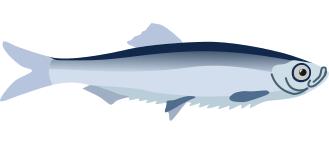
Significantly higher herring volumes were recorded this year, with a total catch of 214,000 tonnes, compared with 115,000 tonnes last year. Vessels from several nations contributed to the increased volume. Norwegian vessels caught 157,000 tonnes, Faroese vessels 41,000 tonnes, British vessels 14,000 tonnes, and two Danish vessels accounted for 2,000 tonnes.
For buyers and the processing industry, the additional 100,000 tonnes compared with last year has contributed positively to maintaining a higher level of activity. All herring has been sold for human consumption, primarily for filleting. Trimmings from processing are used for the production of fishmeal and fish oil.
The winter fishery started in the fjords of northern Troms (Kvænangen) just after the New Year, and the final catch was taken on 7 March west of Helgeland. In total, 163 different vessels, large and small, participated in the fishery.
Fishermen reported periods of high herring abundance. One challenge has been the presence of smaller herring from the 2021 and 2022 year classes in some areas. This is a natural development as younger year classes enter the stock. We now await with interest the first results from the spawning survey conducted by the Institute of Marine Research in the latter part of February.
Blue whiting
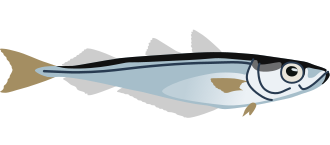
In contrast to NVG herring, blue whiting volumes have decreased significantly this year. This is due to a substantially lower quota, with the Norwegian quota set at 239,000 tonnes, compared with 406,000 tonnes last year.
The first Norwegian blue whiting catch was landed on 20 January from the Faroese zone. From the EU zone, Malene S was the first vessel to report a catch on 28 January. So far, Norwegian vessels have caught 178,000 tonnes, of which 121,000 tonnes were taken in international waters west of Ireland. 55,000 tonnes were caught in the EU zone around the Porcupine Bank, and 2,000 tonnes in Faroese waters. One Danish vessel has caught 7,000 tonnes of blue whiting over three trips. At the same time last year, total catches amounted to nearly 300,000 tonnes.
The blue whiting fishery has been uneven throughout the season, with weather conditions again hampering fishing activity. The most productive period occurred in international waters, where vessels filled their holds quickly with few trawl hauls. The best week this winter was week 8, with 44,000 tonnes landed.
Mackerel
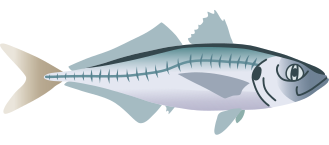
Mackerel volumes have also declined significantly. Winter landings total a modest 9,000 tonnes, compared with 39,000 tonnes last year. Of this year’s volume, British vessels accounted for 6,800 tonnes, two Danish vessels 1,300 tonnes, and three Norwegian vessels 900 tonnes.
The main reason for this sharp decline is the substantial reduction in quotas, combined with increased requirements for British vessels to land 70% of their catches in domestic ports.
Horse mackerel / coastal sprat
For the smallest vessels fishing for horse mackerel in the fjords, the winter fishery has been slightly better than last year. In total, just under 670 tonnes were landed, compared with 470 tonnes last year. This mainly consists of large horse mackerel, with fishing activity concentrated in Rogaland and Vestland.
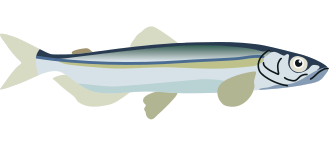
For coastal sprat, volumes total 330 tonnes, broadly in line with last year’s level. All sprat has been caught in the outer parts of the Oslofjord area.
Baltic sprat
Danish and Swedish vessels have experienced a strong sprat fishery in the Baltic Sea this winter. A total of 11,400 tonnes has been landed to Norway from three vessels. This sprat is used for the production of fishmeal and fish oil.
Sales
The total first-hand sales value so far this year is at approximately the same level as last year, around NOK 3.7 billion. NVG herring contributes most positively, while mackerel has a negative impact compared with last year.
Weekly updates on sales values are available at the following link: Quota overview | Sildelaget.no
Bergen, 23 March 2026
Kenneth Garvik
[email protected]