


The course of the fisheries per week 4 - 2026
 Photo: Bernt Sortland
Fantastic week for herring in the north. And positive developments for horse mackerel in the southwest for the smallest boats.
26.01.2026 08:58 | By Martine KorsøenNVG-herring:
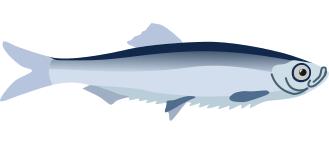
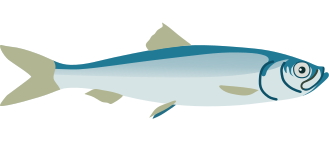
We had by far the best herring week of the winter, with a total of 56,000 tonnes reported. This volume was caught by 80 different vessels, with catches ranging from 15 tonnes from a coastal boat to as much as 2,650 tonnes from the Faroese vessels Gøtunes and Christian í Grótinum. The best reporting day was Monday with 11,700 tonnes, closely followed by Sunday with 10,500 tonnes.
The contribution to the weekly volume is distributed fairly evenly between the different fleet groups. The foreign vessels from the Faroe Islands caught 16,600 tonnes, the purse seine fleet 15,100 tonnes, the coastal fleet 13,800 tonnes, and the trawl fleet delivered 10,600 tonnes.
Fishing in the north has taken place inside Altafjorden, west of Sørøya, and about 15 nautical miles northwest of Torsvåg lighthouse. The herring is clearly migrating towards the spawning grounds further south. The size of the catches varies significantly, with the smallest averaging 190 grams and the largest reaching 320 grams. Since the largest herring is most attractive in terms of price, we see considerable price differences between the size extremes.
Buyers report that the quality of the herring remains good, with decent fat content and that the herring is not yet far along in roe development. For most catches, skinless fillets are being produced for the premium herring markets.
A look at the quota situation now shows that Norwegian vessels have caught around one-third of the 343,000‑tonne quota, amounting to 116,000 tonnes. The Faroese vessels have now caught 20,100 tonnes in the Norwegian economic zone. The Faroese quota is 53,400 tonnes, and they are permitted to fish the entire quantity in our zone. This access, as far as we know, is valid until the end of February.
We expect continued strong participation in the herring fishery moving forward, especially from the Faroese vessels.
Blue whiting:
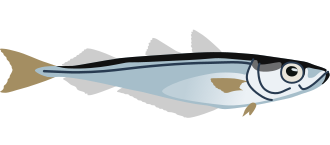
One vessel has reported just under 1,600 tonnes. This catch was taken in the Faroese zone, where vessels from several nations have been fishing since New Year.
We now expect more vessels to head west into the EU zone for blue whiting fishing over the coming weeks, before moving into international waters later in February.
Mackerel:
As expected, there were few mackerel reports. The entire volume last week consists of a small 5‑tonne catch from a coastal vessel fishing at Bømlo. In addition, we have 300 tonnes from a Norwegian vessel fishing west of Shetland, and 490 tonnes from a Scottish vessel fishing southwest of the same island group.
The mackerel west of Shetland is around 460 grams, while the coastal mackerel is about 300 grams.
Horse mackerel:
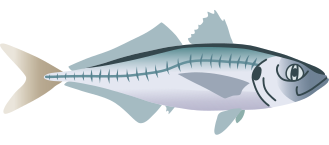
We received a significantly higher volume of horse mackerel than in previous weeks. Eleven different vessels reported just under 300 tonnes, with Monday being the best day at 144 tonnes. The catches were taken in the fjord systems in Rogaland and Vestland. The fish size ranges from 480–600 grams.
The reasons for the stronger week in this fishery may be the favourable weather conditions and the effect of the new moon, which occurred on Sunday, 18 January.
Sprat:
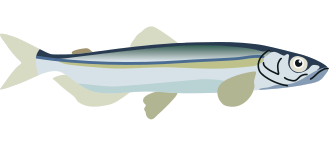
Three vessels reported just over 200 tonnes of coastal sprat. Two of the vessels fished in the outer Oslofjord, where the sprat size is in the range of 70–75 pieces per kilogram.
One vessel operated in the Trondheimsfjord. There is a lot of fish registered here, but it is difficult to find sprat separated from herring. As a result, only a small mixed catch was taken.
Bergen, 26 January 2026
Kenneth Garvik
[email protected]