


The course of the fisheries per week 42 - 2024
 Photo: H Østervold
A great week for herring fishing up north.
21.10.2024 08:30 | By Anette UddénNorwegian Spring-Spawning Herring (NVG Herring):
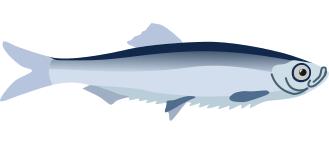
It’s been a great week for herring fishing up north, with the best week of the year so far, recording a total of 44,400 tons. The best single day was Thursday, with 12,700 tons registered.
A total of 60 different vessels, both large and small, have been involved in herring fishing, with purse seiners leading the way, catching 34,800 tons. Coastal vessels landed 6,000 tons, trawlers 2,100 tons, and two foreign vessels brought in 1,500 tons.
The main fishing grounds have been in the Lopphavet area and outside the fjord lines on both the west and east sides of Arnøy. The herring has tended to form very thin layers at night, which many attribute to the full moon. Those quickest to the fishing grounds found good schools during the daytime, with some successful hauls reaching up to 1,250 tons.
Buyers are reporting good quality herring, with an ideal fat content for skinless fillet production. In addition, some catches are being packed whole or in parts for freezing, with reports of a strong market for the larger herring. Sizes range from 240 g to 342 g, with an average weight of 312 g.
From an Icelandic vessel that fished just under 1,200 tons east of Iceland, we are seeing even larger herring, with average weights between 350 and 395 g. This is likely herring from older year classes compared to the 2016 class currently being fished in Norway.
With weekly volumes like this, the quota is quickly being depleted. Of this year’s quota of just under 256,000 tons, only 101,600 tons remain. With this pace, there will be only modest amounts of herring left for late November and December.
Mackerel:
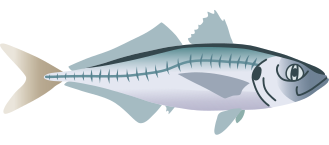
Autumn, with its series of low-pressure systems, has affected the areas where mackerel fishing is taking place, resulting in only 12,600 tons being caught last week. The best day was Saturday, with 4,900 tons landed.
As expected, foreign vessels contributed the most, with eight different boats bringing in 8,600 tons. The remaining amounts were split between Norwegian vessels: purse seiners 2,000 tons, coastal vessels 1,500 tons, and trawlers 500 tons.
Except for a few hundred tons caught along the coast of southern Norway by smaller vessels, the fishing has been in the same area as previous weeks, southeast of Shetland.
The size of the mackerel in the British zone varies greatly from catch to catch, with a significant portion under 250 g in some cases. The lowest average weight is 330 g, while the highest is 471 g.
Prices are expected to vary significantly due to the wide range of average weights.
Several vessels have taken advantage of the flexibility option, allowing them to catch up to 10 percent of next year's quota in advance. This is reflected in the quota overview, where 245,000 tons have already been caught out of this year’s quota of 237,000 tons.
This volume will continue to rise, as some vessels have yet to land their mackerel quotas.
North Sea Herring:
It’s also been a challenging week for those still fishing North Sea herring, due to bad weather. Only 1,300 tons were caught last week.
Vessels in the British zone landed just under 900 tons, with average sizes ranging from 153 to 215 grams. The remaining 430 tons were caught along the Norwegian coast and in the Norwegian part of the North Sea.
The herring caught along the coast is larger, with average weights over 300 g, while those caught offshore range from 155 g to 205 g.
Blue Whiting/Norway Pout etc.:
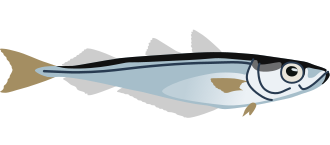
Only three vessels fished along the "Edge" last week, landing 1,250 tons of blue whiting and 300 tons of Norway pout.
In addition, a Danish vessel (Astrid) caught 1,600 tons of boarfish. The catch was made using a trawl about 100 nautical miles south of Ireland.
This article has been translated using ChatGPT and may contain errors.